Full SaaS · not a prototype · ten working days

I build the whole SaaS, not a prototype.

For non-technical founders: a real product your customers install and pay for. One app that runs on their phone, their desktop and in the browser, with Stripe payments and accounts wired in — plus the landing page, blog and every word of copy. 10 working days. $3,000 $999. Zero equity.

  • PWA — installs on iPhone & Android
  • Desktop + browser, one codebase
  • Stripe payments & accounts, live
  • 10 working days

Somewhere, someone else just had your idea. Be the one who's live first.

The call is free and 30 minutes max. No pitch deck needed — one paragraph about your idea is enough.

10+
years shipping production software
04
products of mine you can open and use right now
10 days
working days — intro call to production launch
$999
flat — down from $3,000, agreed in writing before we start

01 — The shift

Building products changed. Buying them didn't — until now.

AI collapsed the cost of writing software. What used to take an outsourced team half a year now takes a disciplined system ten working days. You're not choosing between freelancers — you're choosing between eras.

The old race
  • Hire an agency or an outsourced team
  • Everything written from scratch
  • 3–6 months to a first release — often a demo, not a product
  • $15k–50k, billed by the hour
  • You see the result at the end — and hope
This offer
  • One senior engineer running a proven system
  • Assembled on a stack that already runs paying SaaS
  • A full product live in ten working days — not a prototype
  • $999 flat, agreed in writing
  • You watch it ship — staging link from day one

The moat isn't code anymore — it's days. Every week spent collecting agency quotes is a week your competitor spends learning from real users.

01 — Made & shipped

Real products, with my fingerprints on them.

04 live products · 01 open system

Products you can open right now, subscriptions you can actually buy, and the open-source build system behind them.

01
live · paywall on
01 — SHIPPED SAAS

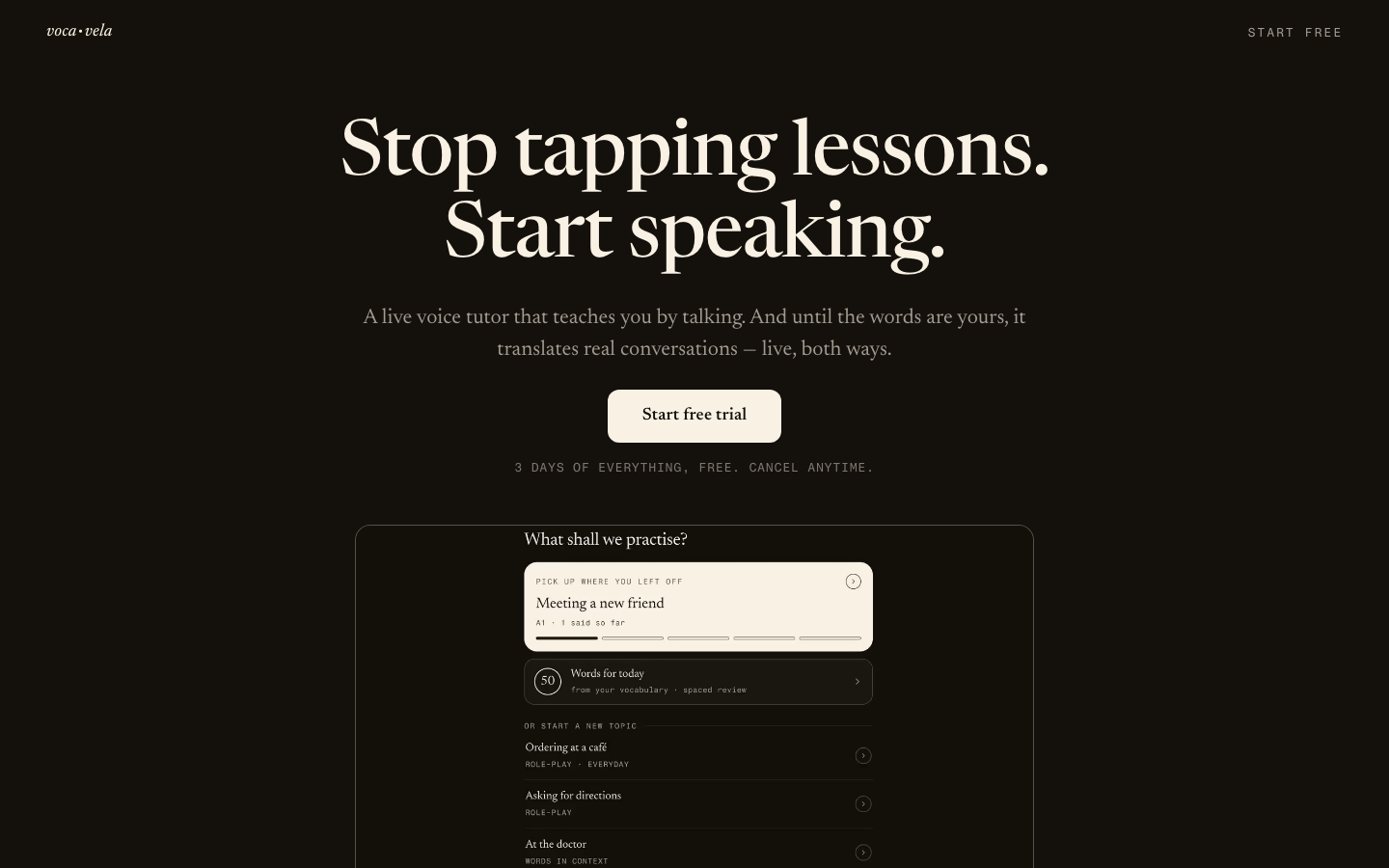
Vocavela

vocavela.live · realtime voice AI · 39 languages
launched [month year] · [traction: users / subscribers] fill

"Stop tapping lessons. Start speaking." Live voice conversation with an AI tutor that translates and corrects as you talk, camera translation for menus and signs, and a phrase library built from your own conversations. A complete commercial product — free tier, trials, monthly subscriptions and lifetime plans, all running through a live Stripe paywall.

Visit the live product
02
live · paid plans
02 — SHIPPED SAAS

Messaging.Quest

messaging.quest · multi-agent outbound · from $33/mo

Paste a URL, get a researched cold-email campaign. A crew of agents reads the site, finds the companies that fit, verifies real people, registers and warms the sending domains, and writes one personal message per person — then sends it paced, and pauses itself if anything looks risky. The free pilot runs live in about ten minutes, and nothing sends without the founder's approval.

Visit the live product
03
live · in pilot
03 — SHIPPED SAAS

The Quest Board

play.messaging.quest · builders helping builders

A proof-of-help exchange for people who just launched something. Do one honest quest for another builder — read their page, test-drive their product, or make a warm intro — and earn gold that buys the same help back on yours. No upvotes, no review-swaps: every quest has a checklist, and an honest "this isn't for me" pays exactly the same as praise.

Visit the live product
04
live · paywall on
04 — SHIPPED SAAS

Fitting Room

fittingroom.my · AI virtual try-on
launched [month year] · [traction: users / try-ons] fill

An AI fitting room — shoppers see clothes on themselves before they buy, from any device. Built end to end with the system below, and most of that system goes back to the community for free.

Visit the live product
free · open source
05 — THE SYSTEM

Starter Kit

github.com/theic · Claude Code plugin

The system the products above were built with — a free repo with a Claude Code plugin, a predefined tech stack and wired-in setup for Stripe, Vercel, Supabase, Resend and PostHog. Read it before you hire me: it's exactly how your project will be run.

Get the repo
in the lab
06 — NEXT FROM THE LAB

[Product name] fill

organic social · trend-jacking · idea validation

Shipping fast is half the machine — this is the other half: distribution. A marketing engine that watches trends and trending events, drafts posts that ride the wave while it's still rising, and turns the spike into organic traffic. Viral reach instead of ad budgets — ads are never viral, and never cheap. Launch in ten days, then learn in days, not months, whether the idea has a pulse.

Want early access? Mention it on the call

03 — See it work

Don't trust a website. Watch the process.

Reviews can be bought and portfolios can be borrowed — a process can't lie. Below: a raw session of the system taking a feature from spec to deployed, the same way your product gets built.

demo — spec → production

The recorded session is being cut.
Until then, I run it live — on your intro call.

Get the live walkthrough

04 — The ten working days

From first call to first customer.

DAYS 1–201

Scope

One 30-minute call, then a written spec: features, screens, what's explicitly out. You approve it before a single line is written — that spec is what the $999 buys.

DAYS 3–502

Build

Auth, database and the core product loop, plus your landing page and blog — all copy written. A private staging link from day one: you watch progress, not promises.

DAYS 6–803

Money

Stripe wired end to end — subscriptions or one-time, trials, webhooks, receipts, transactional email. The part most first builds get wrong.

DAYS 9–1004

Launch

Your domain, production deploy, PostHog analytics, paywall on. Handover ends with everything in your accounts — GitHub, Stripe, Vercel, Supabase, PostHog.

05 — What founders say

Real words, real launches.

Nothing on this page is stock — and this section is no exception. It ships only with verifiable quotes from real people; until they're collected, ask for references on the intro call. placeholder section

[The outcome quote — a founder on what shipped and when: “We went from a one-page idea to paying customers in a month. I checked the staging link every morning like the news.”]

[Founder name] fill
[product · link to a real profile]

[The trust quote — how the engagement felt: the written spec, daily staging progress, no surprises on price or scope.]

[Founder name] fill
[product · link to a real profile]

[The community quote — someone shipping on the free Starter Kit without you in the room. Proof the system works on its own.]

[Community member] fill
[where they use the kit]

06 — The engagement

One price. Agreed before we start.

$3,000 $999*

flat · installable PWA + payments + landing page + blog · 10 working days · 50% to start, 50% at launch

A technical cofounder costs equity. A full-time CTO costs $150k+ a year. An agency MVP quote starts around $15k. This costs $999 — because the discovery work is already done.

  • Written, fixed-scope spec you approve first
  • Design and full build of the app — a PWA that installs on iPhone, Android and desktop, and runs in any browser
  • Marketing landing page + blog, ready to publish
  • All copy written — landing, blog and product UI
  • Stripe paywall live — subscriptions or one-time
  • Auth, database, transactional email
  • PostHog analytics + Sentry error monitoring, live from day one
  • Production deploy on your domain
  • 100% ownership — code and accounts are yours from day one

Why there's no buy button on this page: a $999 build deserves ten minutes of honesty first. We scope your idea on a free call; if it fits, you get the spec and a Stripe invoice. If it doesn't fit, I'll tell you on that call — not in week three. * The flat price holds for products that fit the predefined stack (Supabase · Stripe · Vercel · Resend · PostHog). Anything custom gets an honest quote before we start.

Book the 30-min call Free, 30 minutes max, no obligation — worst case you leave with a clearer plan.

07 — Who you're hiring

Ten years of shipping. One repeatable system.

I'm a software engineer of ten-plus years, the last several of them deep in AI systems — the models, the agents, and the unglamorous plumbing that keeps them honest in production.

Somewhere along the way I stopped believing in heroic launches. Every product on this page was shipped the same way: a predefined stack, a Claude Code plugin, and checklists for the parts everyone gets wrong the first time — payments, auth, email, deploys. I share most of that system for free, because the system isn't the moat. Shipping is.

CTO as a service is that system pointed at your idea. You bring the product knowledge and the customers; I bring the technical cofounder you haven't been able to find — for ten working days, at a price that doesn't need a committee.

08 — Questions founders ask

The honest fine print.

Why you, and not Upwork with escrow and reviews?+

Escrow protects hours — it can't make months move faster, and reviews rate people, not outcomes. On a marketplace you hire someone to start your product from scratch; here, a system that has already shipped the products above gets pointed at your idea. The risk controls are stronger than escrow, too: 50% at start and 50% only at launch, a staging link from day one, and every commit in your accounts from the first hour — if I vanished mid-build, you'd keep everything. The process is the review.

Why only $999?+

Because discovery is already done. The stack is chosen, the infrastructure is scripted, the pitfalls are catalogued in the Starter Kit — you're paying for execution, not exploration. This is the tenth time I've set this machine up, not the first.

Do you take equity?+

No. Zero, ever. That's the point of the model: you get cofounder-level engineering without giving up a percent of your company. I'd rather earn a fee and a referral than a seat on your cap table.

What exactly is the predefined stack?+

Supabase for database and auth, Stripe for payments, Vercel for hosting and CI, Resend for email, PostHog for product analytics, Sentry for error monitoring — TypeScript throughout, orchestrated by the open-source Starter Kit above. It's public: you can audit every choice before we ever talk.

What if my idea doesn't fit that stack?+

Then the flat price doesn't apply — and I'll tell you inside the first ten minutes of the call, not in week three. You'll get an honest custom quote, or a recommendation to go elsewhere. The ten-working-day promise only works because I refuse bad fits.

Who owns the code?+

You do, completely. Everything is created in your GitHub, Stripe, Vercel and Supabase accounts from day one — code, data, customers, IP. If we part ways at any point, you lose nothing.

What happens after launch?+

You get a handover walk-through and written docs. If you want me to stay on — new features, hiring your first engineer, scaling — we set up a simple monthly retainer. No lock-in either way.

What if something's broken at launch? fill+

[Your guarantee — the strongest trust lever on this page, and only you can commit to it. E.g. “anything broken within the agreed scope is fixed free for N weeks after launch.” State it plainly, no asterisks.]

What do I need to prepare for the call?+

One paragraph about the idea and who it's for. A pitch deck is fine but unnecessary. If you have sketches, competitors you admire, or an existing audience — bring those; they make the spec sharper.

Next step

Thirty minutes. Bring the idea.

The call is free and the spec is concrete. The race, though, won't wait — every week you're not live is a week someone else is learning from your users.

Prefer email? serhiilahutin@gmail.com